We Really Oughta Know Where We Are (Even When the Ground Keeps Shifting)
Bonni Stachowiak9 min read
I’ve been in the field of learning and teaching my entire career. I would argue I’ve been doing it since I was five, but it might be more accurate to say it is who I am. When you’ve been doing this sort of work as long as I have, it can be hard to be patient when grappling with the same challenges repeatedly. A common one: training seems to be the answer to everything, when it hardly ever is.
A flowchart for a world that can be contained and ordered
I have a set of books that sits on a prominent shelf in my home office, which I have frequently referenced over many decades. At the top of the set of six rests Analyzing Performance Problems by Robert Mager and Peter Pipe. The subtitle is among my all-time favorites: or, You Really Oughta Wanna: How to Figure Out Why People Aren’t Doing What They Should Be, and What to Do About It.
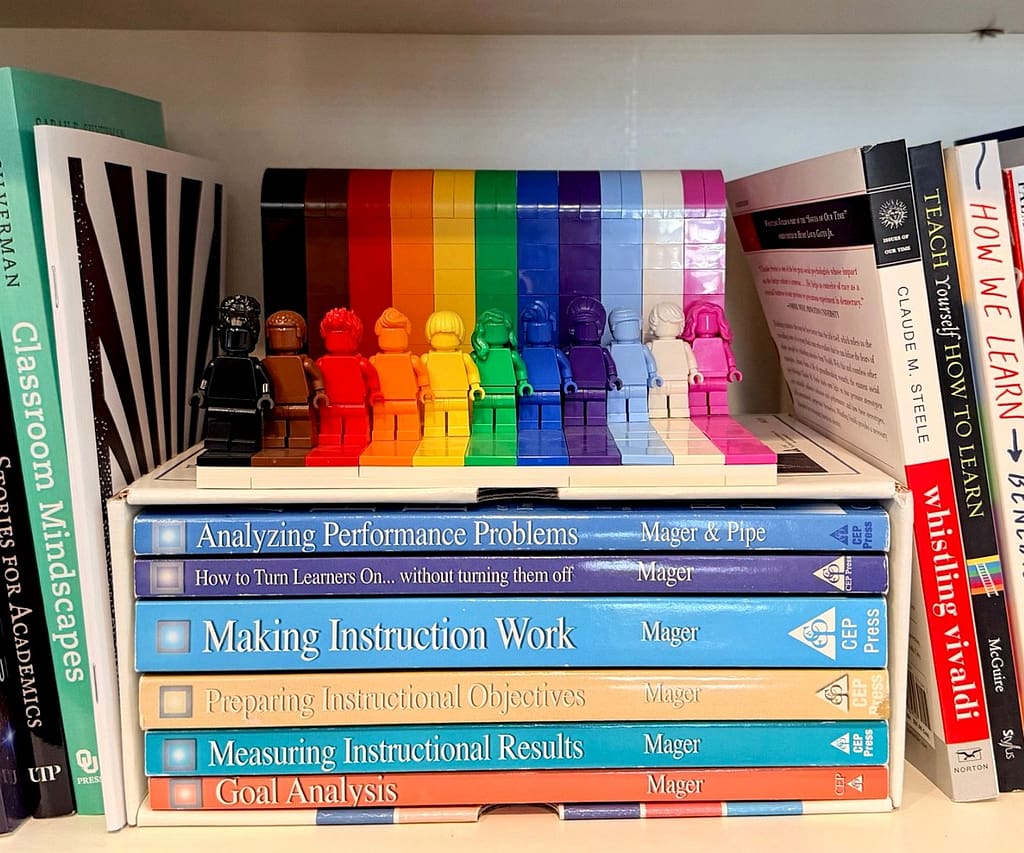
What I have liked about this resource since discovering it in the late ’90s is how neatly, and in such an orderly way, it moves people off of training as the default solution. Mike Taylor, a learning and development expert, describes how the Mager and Pipe flowchart helps people identify solutions that don’t involve training before training becomes the center of any fix.
We humans can enjoy putting some order to chaos, and what better way to do that than to follow a clearly defined process?
At the top of the flowchart is the question of whose performance is concerning you, and an invitation to describe the discrepancy between what is expected and what the person has been doing. Then comes one of my favorite questions: is this discrepancy worth pursuing? It takes a lot of self-awareness to determine whether something is actually worth solving before we plow ahead.
From there, the Mager and Pipe flowchart walks us through whether the person has adequate resources, whether the quality of their performance can be observed, whether doing the right thing is punishing (or doing the wrong thing rewarding), whether consequences are used effectively, whether there is a genuine skill deficiency, whether the task could be simplified, and whether other obstacles stand in the way.
Note: (Regarding misaligned rewards, I can never resist pointing people to Steven Kerr’s classic, On the Folly of Rewarding A, While Hoping for B.)
Only near the very bottom of the flowchart does training even get mentioned. Mike Taylor sums up the bottom line:
Remember, not all performance issues require training. By using Mager’s flowchart, you’ll be able to identify when training is the right solution and when other interventions are more appropriate. This will help you avoid the costly mistake of sending training to do a job it’s not suited for, and instead focus on implementing solutions that directly address the root causes of performance gaps.
What the Mager and Pipe performance analysis flowchart assumes
This flowchart has been something I’ve pointed people toward for decades because it moves conversations off the easy fix that people think training is and offers some nuance and other potential interventions. However, I increasingly notice what is missing when we try to fit the world we find ourselves in today into a flowchart.
Consider that this entire framework assumes that someone knows what behavior should be expected (as part of a broader organizational effort to presumably solve problems, or at least meet existing needs). Someone is the authority on what we all ought to be doing. And it assumes that it can all be boiled down to behavior: a lack of clear expectations, or misaligned rewards and punishments.
The whole flowchart represents a world in which problems are easy to define and solutions are clear.
Candidly, it also treats the person having the flowchart inflicted upon them pretty poorly, all too often. It’s a riff on the banking model of education, where education is seen as a means for pouring knowledge into passive learners’ minds. Here, we dump performance expectations on a passive worker, who apparently has no value to add in making things better?
One of the more frustrating aspects of higher education’s response to the continued emergence of artificial intelligence is the overwhelming quantity of interventions that treat these massive disruptions in a way that assumes that training is the answer. If only we could get enough faculty in a room, they tell us, we would all be “fixed” and the problem that is AI could be “solved” and we could all move on to more important things. Not everyone approaches it this way. But too many people in positions of power are dictating responses that don’t match the kind of problem we’re actually facing: one that calls for a collective response.
Cynefin: matching how we respond to what we face
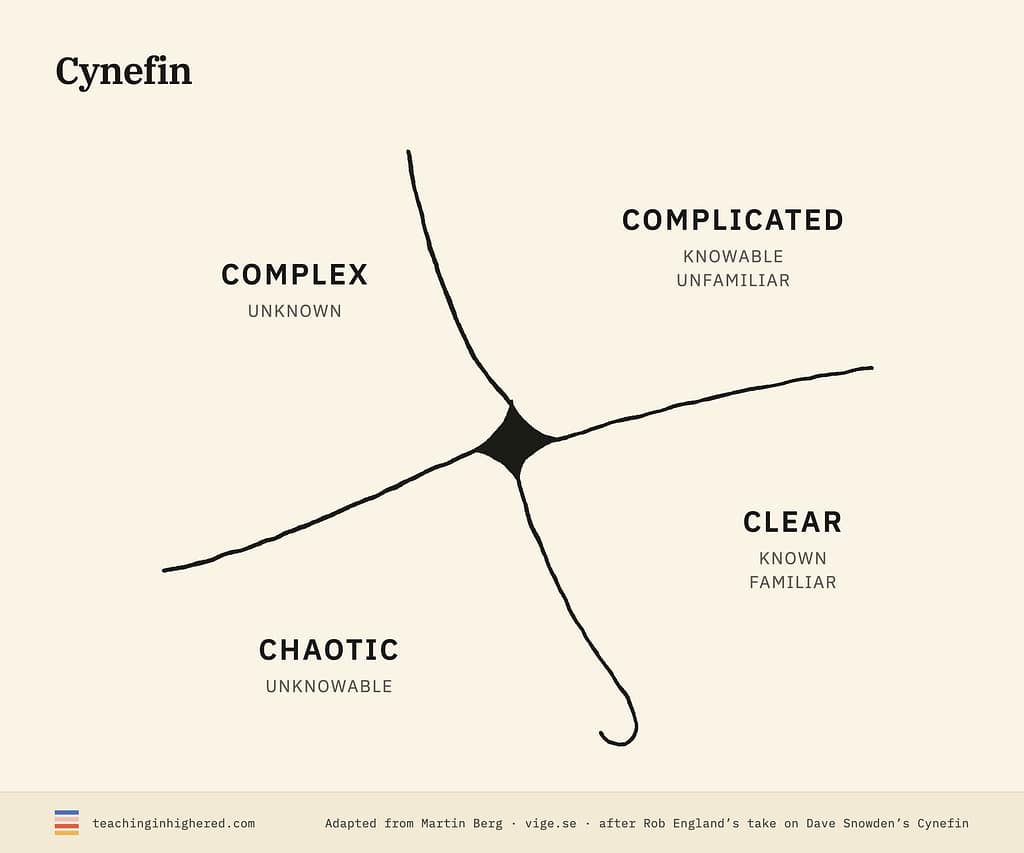
A framework that helps us understand the limits of the Mager and Pipe flowchart is named with a word pronounced entirely differently than it is spelled. I had to struggle for a while and practice until I could see the word and get to the right pronunciation. Cynefin (it rhymes with “seven”: kuh-NEV-in) is a Welsh word, often translated as “habitat,” which Dave Snowden used to name his sense-making framework. The Cynefin Centre describes it this way:
The Cynefin® framework was developed to help leaders understand their challenges and to make decisions in context. By distinguishing different domains (the subsystems in which we operate), it recognises that our actions need to match the reality we find ourselves in through a process of sense-making. This helps leaders cultivate an awareness of what is really complex and what is not and respond accordingly, so that no energy is wasted in overthinking the routine but they also never try to make the complex fit into standard solutions.
At the risk of reviving any traumatic Donald Rumsfeld memories for anyone: in his 2002 news briefing, he clumsily stumbled onto something useful (or otherwise tried to regurgitate something he had heard). There are known knowns (things we know we know), known unknowns (things we know we don’t know), and unknown unknowns (things we don’t even know to ask about). Plenty of us watching that day were left utterly confused. I’m not here to defend a devastating war, just to borrow the vocabulary of someone else trying to make sense out loud, as that administration continued to lay the groundwork for the war’s justifications.
Cynefin’s four domains sort situations by what can be known, and by what kind of response each one calls for:
- Clear — known, familiar: What Rumsfeld called the ‘known knowns’: things where cause and effect are clear, what Dave Snowden refers to as contained. We can set goals and our responses are ordered.
- Complicated — knowable, unfamiliar: What Rumsfeld called the ‘known unknowns.’ Cause and effect can be worked out, but it takes analysis or expertise. Snowden often introduces clear and complicated together as simply ‘order’, only later separating self-evident practice from practice that requires experts.
- Complex — unknown: The ‘unknown unknowns.’ This is where what Snowden calls ‘exaptive discovery’ comes in, in which we only know cause and effect after we have already begun to act, and we often discover along the way something that works in an unexpected way. Snowden describes: “Some constraints, but everything is connected and we don’t know what the connections are. We can assess probability but cannot predict.”
- Chaotic — unknowable: It is here that under stress, novelty may emerge. Snowden explains the chaotic as: “one of apparent randomness in which there are no effective constraints and the goal of the decision-maker should be to act decisively in such a way as to maximise options, not to resolve the issue.”
Mager and Pipe’s tool can be helpful in what Cynefin calls the ordered domains: clear and complicated. Many of us have spent ample time in our careers in the complicated domain, where the knowledge and skills we are seeking are knowable but unfamiliar to us. Expertise, analysis, and a lot of late nights reading might be able to get us there. The flowchart’s diagnostic questions are exactly that kind of analysis. It just presumes that somebody, somewhere, already knows the answer.
Learning when the answers aren’t known in advance
Harold Jarche explains what this all means for how we design learning when the work doesn’t fit neatly into existing, or even knowable, practice:
The Cynefin framework can help us connect work and learning, especially for emergent and novel practices, for which we do not have good or best practices known in advance. When we want to create a conducive learning environment for knowledge workers, the Cynefin framework helps us see the inherent weakness of instructional systems design (ISD) — designed for formal learning — which works from the premise of predetermined learning objectives and activities, usually based on good and best practices observed in the workplace.
As Harold discusses learning in the complex domain, we are confronted with the ways we must adjust our ways of seeing to grapple with the unknown. In the PKM workshop materials, he stresses how vital communities and networks are, and why the most structured ones aren’t enough:
Formal networks can be echo chambers, therefore open knowledge networks and informal communities consisting of more diverse perspectives are necessary to speed the flow of knowledge.
Two modes for every form
Harold Jarche’s PKM connects work and learning graphic (from his learning in the complex domain post) contrasts two halves of Cynefin: the ordered domains and the complex domain.
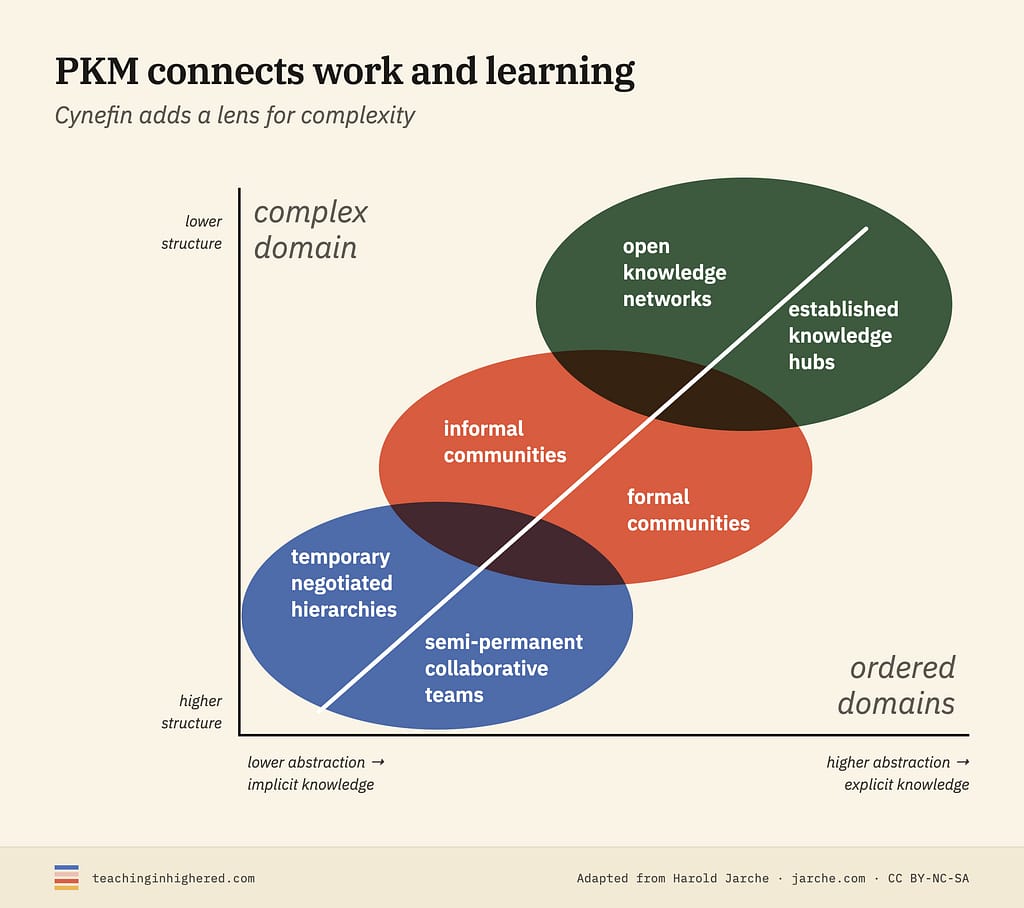
When we have explicit knowledge (knowable solutions), knowledge hubs, formal communities, and semi-permanent collaborative teams can be effective. However, when we enter complex territory and must adapt as we go, that’s where open knowledge networks, informal communities, and temporary negotiated hierarchies are vital.
Learning about and responding to AI as we are going
So far, I’ve critiqued how too many people in higher education are treating AI as an orderly problem, without offering an alternative. I certainly don’t pretend to have the answers (that’s kind of the point, isn’t it?). However, I draw inspiration from many of the people I’ve been able to talk with for the podcast, or be in community with, as we attempt to navigate this using complex-domain responses.
Instead of mandatory workshops, let’s look to examples like Teddy Svoronos gathering faculty, PhD students, and teaching experts to puzzle through how statistics should be taught now. Or Remi Kalir and his collaborators exploring the questions about AI worth pressing on (episode 647). Or Northeastern inviting faculty to spend a year studying their own experiments and sensemaking. Or the open, cross-institutional conversations at MYFest. None of these efforts assumes someone already knows the answer or precise path to follow. Instead, they create the conditions for us to find out, together, and learn through what is emerging.
I mentioned earlier that it has taken me considerable time to get enough retrieval practice going for myself to be able to pronounce Cynefin, let alone think I understand it yet. I’m thankful for this opportunity for some productive struggle this morning, though I recognize there’s so much more to learn. This post is part of my continued learning in my second time through Harold Jarche’s Personal Knowledge Mastery workshop, his final offering of this program. Here’s to more sensemaking opportunities in the weeks to come, as the workshop concludes.
Image Credits
Featured image photo and bookshelf photo in article by Bonni Stachowiak
Cynefin image adapted from Martin Berg, Cynefin, based on Rob England’s interpretation of Dave Snowden’s Cynefin framework
PKM connects work and learning image by Harold Jarche, Learning in the complex domain, CC BY-NC-SA 4.0.